
Views: 0 Author: Site Editor Publish Time: 2026-10-08 Origin: Site


You spend hours routing a custom display sign. You carefully mount a large-format photograph to a perfectly flat panel. Then, you return the next morning to find your substrate curled like a potato chip. Watching a rigid board suddenly bow into a severe curve after making a single cut is a fabricator's worst nightmare.
This distortion is almost never a manufacturing defect. Rather, cutting just one side of a PVC Foam Board disrupts its delicate internal tension. When you slice through the outer skin, you permanently alter the mechanical equilibrium of the plastic. The material is simply reacting to physics.
As a fabrication engineer, I see this issue constantly in the shop. In this technical guide, we will break down the exact physical science behind this frustrating deformation. Beyond theory, you will discover actionable prevention techniques, thermal salvage methods for warped boards, and professional criteria for upgrading to denser, warp-resistant substrates.
Tension Imbalance: Cutting, scoring, or laminating only one side of a plastic panel releases surface tension. This forces the uncut side to pull and distort the material.
Material Density Matters: Standard free-foam boards are inherently more prone to bowing. Denser alternatives like Celuka or solid rigid panels offer vastly superior structural stability.
Prevention is Mandatory: Employing double-sided scoring, balanced adhesive application, and high-RPM cutting tools prevents structural deformation before it starts.
Thermal Recovery: Warped boards can sometimes be salvaged using controlled heat application, counter-bending, or applying a balancing layer to the opposite face.
To understand why a flat board suddenly bows after a blade passes through it, we must examine the physical properties of the plastic itself. Warping is a highly predictable physical reaction to asymmetrical stress.
During manufacturing, these panels are created through a continuous extrusion method. The raw polyvinyl chloride resin mixture is pushed through a heated die and immediately enters a cooling calibrator. The outer surfaces of the board come into contact with the cooling calibrator first. Because of this, the outer skin solidifies much faster than the inner foamed core.
This differential cooling rate locks the polymer chains on the surface into a state of high tension. The top and bottom skins actively pull against each other with equal force. Meanwhile, the softer foamed core acts as a stabilizing bridge. As long as this tension remains equal on both the top and bottom faces, the board remains perfectly flat.
When you drag a utility knife deeply across only one side of the panel, you sever the rigid polymer chains on that specific surface. Imagine the board's surface tension like two stretched rubber bands glued to the top and bottom of a sponge. If you snip the top rubber band, it instantly loses its pulling force.
As a result, the bottom rubber band remains completely intact and continues to pull. Lacking the counter-force from the top layer, the bottom layer pulls the edges of the board inward. The material inevitably bows toward the uncut side. In material science, we call this shifting the neutral axis. Removing structural material from one face mathematically guarantees a curve.
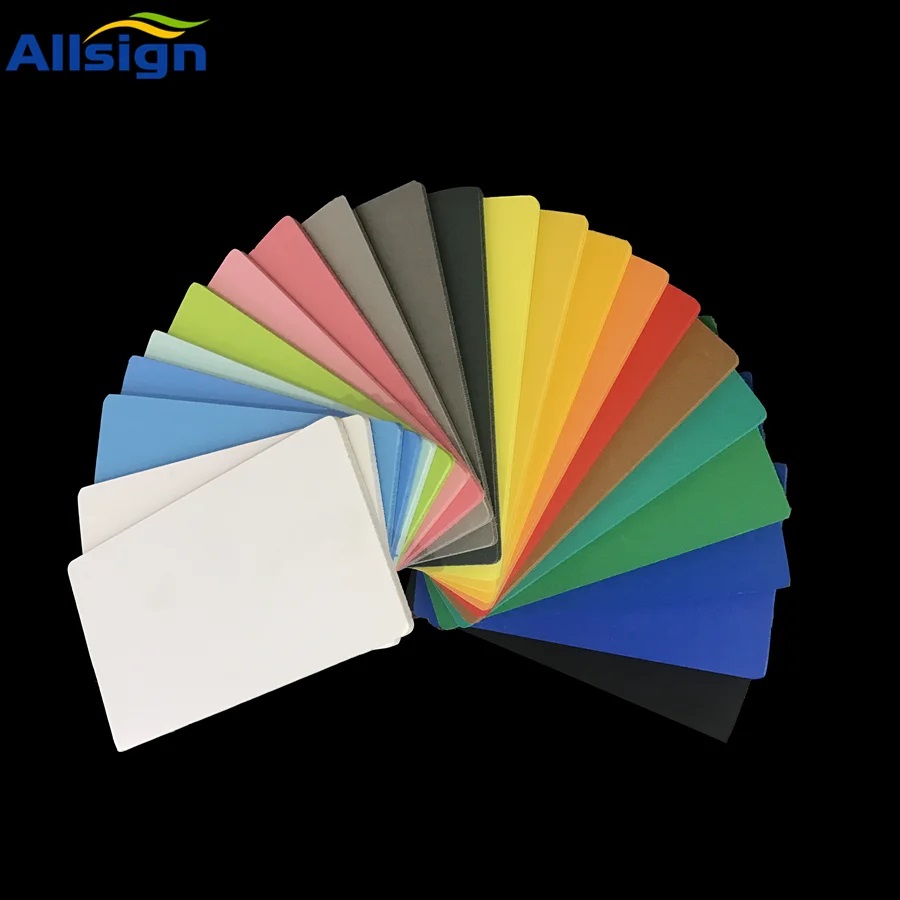
While asymmetrical cutting is the most immediate cause of distortion, it is far from the only stressor in a busy shop. Professional fabricators frequently encounter bowing even when a blade has never touched the plastic. This typically occurs when external chemical or thermal forces are applied unevenly.
One of the most common applications for these panels is mounting fine art photographs, vinyl graphics, or architectural prints. When wet adhesives like polyvinyl acetate glues or water-based pastes are applied to a single face, they introduce massive chemical stress.
As the adhesive dries, the water or solvents evaporate. This causes the glue layer to physically shrink. Because the adhesive is bonded tightly to the non-porous plastic surface, its shrinkage acts like a contracting muscle. It exerts a massive pulling force, and the board will curl toward the glued side.
Similar to wet adhesives, liquid paints undergo a physical transformation as they cure. Heavy acrylics, enamels, and industrial spray paints contain solvents that flash off over time. As the paint film dries, it contracts tightly.
If a heavy coat of paint is applied to only one side of a Decorative PVC board, the contracting film will pull the edges inward. The thicker the paint layer, the stronger the pull. Professional sign makers adopt a strict policy of painting the back to save the front. Applying a clear coat or primer to the rear equalizes the curing tension.
Polyvinyl chloride is highly resistant to moisture absorption. However, it remains incredibly sensitive to temperature fluctuations. The material possesses a specific coefficient of linear thermal expansion. When exposed to heat, the plastic expands rapidly.
If a panel is left leaning against a wall with direct sunlight hitting only one face, the sun-exposed side will heat up and expand. The shaded side remains cool and contracted. This thermal asymmetry forces the board to warp permanently if left unchecked.
Over the past few years, the commercial signage and architectural modeling sectors have experienced a massive shift in material standards. As automated CNC routing and high-speed digital UV flatbed printing become global norms, the tolerance for material deformation has dropped to near zero. Fast-curing UV inks introduce intense surface tension, and high-torque milling bits exert immense lateral force.
Industry analysts note a growing trend where fabricators are rapidly moving away from standard low-density foams for premium projects. Instead, the market demand is heavily skewing toward engineered, high-density substrates. Modern shops require boards that can withstand asymmetrical stresses without yielding to a bow, driving innovation in extrusion technology.
Not all plastic panels react to stress in the same way. The manufacturing methodology and core density dictate exactly how much tension the board can withstand before yielding. Selecting the correct substrate is the absolute best way to mitigate deformation.
Below is a technical breakdown of how different board classifications handle fabrication stress, based on standard industry parameters.
Material Type | Density Range | Thickness Range | Warping Resistance | Best Application |
|---|---|---|---|---|
Standard Free-Foam | 0.35 - 0.8 g/cm³ | 1mm - 40mm | Low to Moderate | Lightweight crafts, indoor short-term signage |
Celuka Board | 0.45 - 0.9 g/cm³ | 3mm - 30mm | High (Rigid Skin) | Cabinetry, outdoor signage, CNC routing |
Solid Rigid Board | 1.40 - 1.50 g/cm³ | 1mm - 30mm | Maximum | Heavy industrial use, chemical tanks, load-bearing |
This variant is manufactured using a free-foam extrusion process. The foam expands freely as it exits the die, resulting in a uniform, relatively soft density throughout the core and a matte, micro-porous surface. Because its outer skin is thin and its core is highly aerated, it possesses lower structural rigidity. While excellent for lightweight applications and easy manual cutting, it is highly susceptible to warping when altered asymmetrically.
The Celuka process differs significantly. The expansion of the foam is tightly controlled within a solid calibrator, forcing the foam to expand inward. This creates a PVC Celuka Board with a very hard, dense, and smooth outer skin. Ranging from 3mm to 30mm in thickness, this robust outer shell acts as an exoskeleton. It is highly resistant to the pulling forces of one-sided scoring, heavy adhesives, or UV ink curing.
A Rigid PVC board does not contain a foamed core at all. It is a solid extrusion of unplasticized polyvinyl chloride boasting a high density of 1.4 to 1.5 g/cm³. Lacking internal air pockets, rigid panels offer maximum tensile strength and dimensional stability. They offer a near-zero tolerance for deformation, making them the go-to choice for heavy-duty industrial and architectural applications.
Understanding the physics of surface tension empowers you to adopt shop techniques that prevent distortion entirely. By maintaining structural equilibrium, you can achieve flawlessly flat results.
When cutting panels with a manual utility knife, the standard practice of scoring one side deeply and snapping the board ruins the edge. To prevent this, adopt the double-sided scoring method.
First, measure and mark your cut line on the front face. Use a sharp utility knife to score the material lightly, penetrating no more than twenty percent of the board's thickness. Carefully flip the board over and transfer the exact measurements to the back face. Score the back face to the exact same depth. Finally, snap the board cleanly over a sharp table edge. By releasing the surface tension equally on both sides before the final break, the neutral axis remains completely undisturbed.
Manual scoring inherently introduces pinch-stress. To eliminate this, rely on tools that remove material cleanly without compressing the surrounding plastic. Track saws equipped with fine-toothed carbide blades shear the plastic cleanly. CNC routers utilizing upcut and downcut compression bits are also ideal. They mill the material away evenly without pulling the top skin upward or pushing the bottom skin downward.
If your project absolutely requires applying a heavy layer of shrinking paint or wet adhesive to one side, you must apply a counter-force. If you mount a large, heavy print to the front using wet glue, apply a layer of inexpensive backing paper to the rear using the exact same adhesive. As both sides dry and shrink at the same rate, the opposing pulling forces cancel each other out.
If you have already cut a board and it has curled into an unusable shape, it may not be a total loss. Because polyvinyl chloride is a thermoplastic, it retains a specific memory of its manufactured shape. It can be temporarily softened under the right conditions.
The most scientifically sound approach to flattening a distorted panel relies on thermal manipulation. The goal is to bring the material close to its glass transition temperature, allowing the stressed polymer chains to relax.
Place the warped board on a perfectly flat, heat-resistant surface with the bulging convex side facing upward. Using a heat gun on a low setting, sweep hot air evenly across the surface from a distance of eight inches. Keep the gun moving to avoid scorching the plastic. Once the core feels slightly pliable, immediately place a flat, heavy piece of plywood or thick glass over it. Stack heavy, evenly distributed weights on top. Leave the setup entirely undisturbed for 24 hours until it cools back to room temperature.
For very minor bows, mechanical equilibrium might save the piece. If you made a shallow cut on the front causing a backward bow, carefully flip the board. Make an identical micro-score on the exact opposite back axis. This releases the tension on the rear skin, often allowing the board to snap back to a flat position. Gently flexing the board in the opposite direction can also stretch compressed cells. Do this cautiously to avoid cracking the skin.
It is crucial to assess whether a damaged board is actually worth saving. If the cellular core has been crushed or the outer skin has visible micro-fractures, the structural integrity is permanently compromised. In commercial settings, the labor hours spent attempting to salvage a ruined standard foam board vastly exceed the cost of the raw material. Discarding the warped piece and starting over is often the smartest business decision.
In the exhibition and photography industries, applying mounting media to a single face is a daily task. Adhering to strict mounting protocols minimizes the risk of adhesive-induced curling.
The golden rule for plastic substrates is simple. Completely avoid adhesives that rely on water or solvent evaporation to cure. Instead, utilize dry mounting tissue. This uses a heat-activated film that bonds in a vacuum press without introducing moisture. Alternatively, pressure-sensitive adhesive rolls provide an instant, permanent bond without the curing tension associated with liquid glues. For structural joints, rely on two-part epoxies or cyanoacrylate that cure via chemical cross-linking rather than evaporation.
Environmental asymmetry is a frequently overlooked variable. Never store panels leaning at an angle against a shop wall. Gravity will induce a permanent bow over time. Always store them perfectly flat on a supported pallet. Additionally, if a board is moved from a freezing warehouse into a heated fabrication shop, allow it to acclimate flat on a table for 24 hours before cutting. Sudden thermal expansion combined with a blade cut guarantees a warped edge.
Cutting one side of a foam board fundamentally alters its surface tension. This sudden release of internal stress leads directly to unwanted warping and bowing. By understanding the physics of the material, you can prevent this by utilizing double-sided scoring techniques, high-speed routing, and non-shrinking adhesives.
Choosing the correct material density from the start is paramount to project success. If absolute flatness is non-negotiable for your premium outdoor signage, load-bearing cabinetry, or industrial displays, upgrading your substrate is required. Denser materials like Celuka or solid rigid panels offer vastly superior resistance to one-sided stress.
Ready to upgrade your fabrication materials? Stop fighting with warped boards and invest in dimensional stability. Explore the full range of engineered substrates, from lightweight foam to high-density Celuka and Rigid boards, at Allsign to find the exact match for your next demanding project.
Yes, painting only one side can frequently induce warping. As acrylics, enamels, or latex paints dry and cure, the chemical solvents evaporate, causing the paint film to shrink. This shrinkage exerts a strong pulling force on the surface of the plastic. To maintain mechanical equilibrium, standard industry practice dictates that you should always prime or paint the back side of the board with an equivalent coat to balance the surface tension.
Absolutely. The manufacturing methodology makes a massive difference. The Celuka extrusion process cools the outer layer of the plastic much faster than the inside, creating a hard, dense outer skin while the core remains slightly foamed. This rigid outer exoskeleton significantly increases the board's overall stiffness, making it highly resistant to the one-sided stress that typically bends standard free-foam boards.
No, standard wood glue is highly ineffective and potentially damaging to plastic substrates. Wood glue requires porous surfaces to absorb moisture and dry properly. Because PVC is completely non-porous and waterproof, the glue will sit on the surface, take excessively long to cure, and shrink dramatically as it dries. You should always use PVC-specific solvent cements, cyanoacrylate glues, or specialized double-sided mounting adhesives.
Yes, ambient temperature plays a crucial role in fabrication. Cutting the plastic in excessively cold environments causes the thermoplastic polymer chains to become rigid and brittle, dramatically increasing the risk of cracking or shattering along the cut line. Conversely, cutting it when it is too hot can cause the core material to melt and gum up on the saw blade. For the cleanest cuts, always allow the material to acclimate to standard room temperature before fabrication.
To prevent chipping, avoid using dull blades or low-speed reciprocating saws. For manual cuts, use a fresh, sharp utility knife and take multiple shallow passes rather than trying to cut through the entire board in one go. If using power tools, use a high-speed track saw or circular saw equipped with a fine-toothed carbide blade—specifically designed for plastics or non-ferrous metals. Ensure the board is fully supported underneath to prevent vibration.
Yes, thickness is a major factor in dimensional stability. Thinner boards, such as 1mm to 3mm profiles, have less core material to resist the pulling forces of the outer skin, making them highly susceptible to warping from uneven cuts, heat, or adhesives. Thicker boards, ranging from 10mm to 30mm, possess a much stronger internal structure. The thicker foam core acts as a robust bridge between the two skins, dramatically reducing the likelihood of bowing under asymmetrical stress.


