
Views: 0 Author: Site Editor Publish Time: 2026-10-31 Origin: Site


Are you constantly struggling with bulky event signs that eat into your logistics budget? Many companies overspend on temporary marketing displays simply because they default to traditional cumbersome materials. Finding a cost-effective alternative is essential for modern marketing agility. A high-quality KT foam board solves this exact problem by balancing structural rigidity with an incredibly low mass. In this comprehensive guide, we will explore its core benefits, material engineering, and real-world applications. This practical knowledge will help you optimize your procurement budget without sacrificing visual impact.
Cost-Effective High Impact: These boards offer a premium appearance for a fraction of the cost associated with rigid plastics or solid metals.
Ultimate Portability: As an exceptionally lightweight substrate, it drastically reduces freight logistics costs and minimizes setup time for commercial events.
Versatile Applications: It serves as the foundation for everything from retail point of purchase displays to structural presentation panels.
Easy Customization: The material can be precisely cut, routed, and directly printed on using vibrant UV or eco-solvent ink technologies.
Best for Indoor Use: While highly effective for visual marketing, it is structurally optimized for indoor or short-term outdoor applications to prevent environmental warping.
To make an informed purchasing decision for your marketing collateral, you need to understand the structural engineering behind the materials you choose. This specific substrate has become a staple in the commercial printing and signage industry. Its dominance is primarily due to a unique manufacturing process and highly stable physical properties.
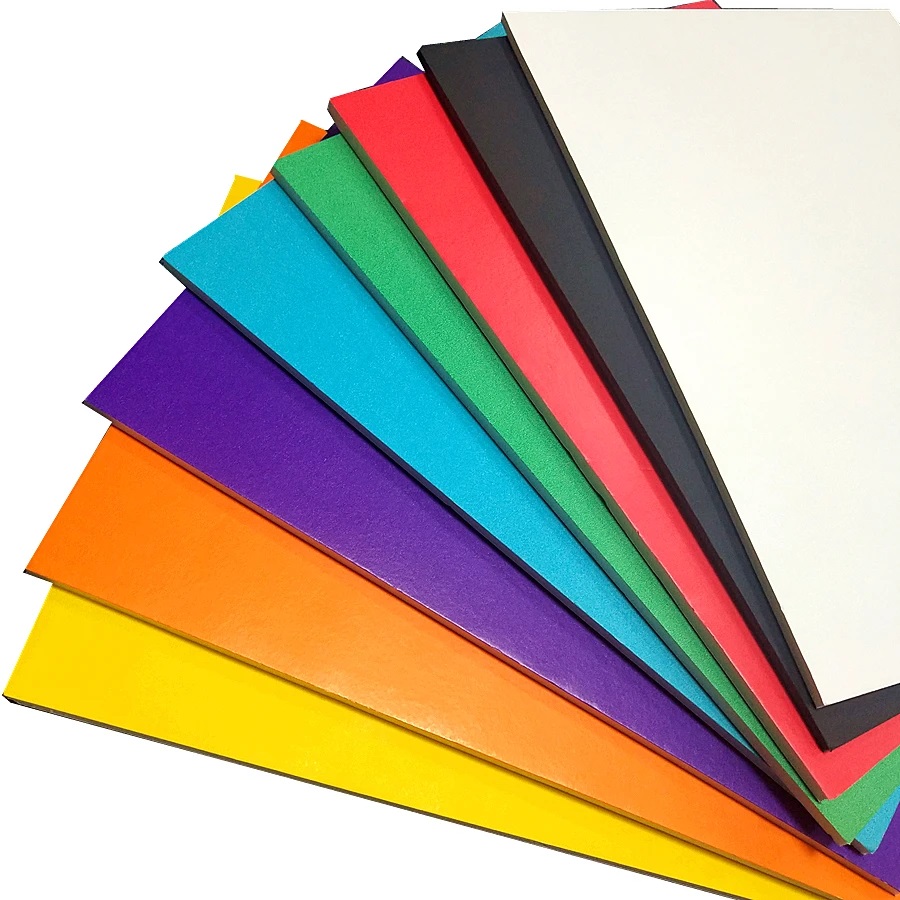
At its core, the board consists of extruded polystyrene foam. During the manufacturing process, polystyrene beads are melted and continuously extruded to form a rigid closed-cell foam matrix. We then sandwich this core between two outer layers. These veneers typically consist of a thin high-impact polystyrene plastic or a specialized coated paper.
This sandwich structure dictates the dimensional stability of the board. The inner foam provides significant volume and thickness—commonly available in standard commercial specifications like 3mm, 5mm, and 10mm—without adding dead mass. Standard sheet sizes such as 1220x2440mm weigh a mere fraction of solid acrylic counterparts. Meanwhile, the outer veneers deliver the necessary tension and compression resistance to keep the panel perfectly flat.
In the competitive landscape of visual merchandising, print quality dictates brand perception. The board stands out because of its ultra-smooth bright-white surface. Unlike corrugated materials that feature visible internal ridges, the flat veneer is engineered specifically for high-resolution graphics. It prevents ink bleeding and ensures razor-sharp edge definition for text and logos. This makes it a highly reliable advertising display board for premium brand presentations.
For procurement managers and marketing directors, selecting the right signage material requires balancing cost against logistical overhead and visual impact. These boards consistently rank as a preferred choice for short-term promotional campaigns due to several measurable business advantages.
Logistics often consume a massive chunk of event marketing budgets. Shipping heavy wooden or solid acrylic signs across the country incurs staggering freight charges and requires specialized handling. By utilizing an engineered lightweight foam board, businesses drastically reduce shipping weight.
Furthermore, the on-site setup process becomes remarkably simple. A single retail employee or event coordinator can effortlessly carry and mount large-format panels. Because the material carries virtually no mass, complex mounting hardware is completely unnecessary. Commercial-grade double-sided tape, hook-and-loop strips, or simple aluminum easels provide a secure and professional installation.
Marketing campaigns are frequently seasonal or tied to rapid time-limited promotions. Investing heavily in permanent signage for a two-week retail sale yields a terrible return on investment. The raw materials and the continuous extrusion manufacturing process are highly scalable. This results in an incredibly low unit cost. Consequently, businesses can allocate more of their budget toward high-end graphic design and broader campaign distribution rather than being bottlenecked by expensive substrate costs.
A display is only as effective as the message printed on it. The specialized outer layer is engineered to interact seamlessly with modern commercial printing technologies. The smooth surface allows for precise ink droplet placement. This precision is critical for rendering high-definition photographs and intricate vector graphics. Whether utilizing UV-cured inks that sit on top of the substrate or eco-solvent inks, the resulting finish is professional, glare-free, and highly engaging.
The versatility of this composite material allows it to be deployed across a wide spectrum of commercial environments. Below are the most effective real-world applications utilized by frontline marketing professionals today.
Walk down any major supermarket aisle during a holiday season, and you will undoubtedly encounter an array of vibrant point of purchase displays. Brands leverage these boards to fabricate eye-catching end-cap headers, promotional aisle signs, and freestanding life-size standees. The material yields effortlessly to digital die-cutting blades. Marketing teams can design custom-shaped silhouettes—like an oversized beverage bottle or a welcoming brand mascot—that physically break the visual monotony of standard retail shelving and trigger impulse purchases.
The bustling floor of a trade show requires a massive volume of temporary high-impact signage. Exhibitors frequently rely on a customized exhibition foam board to construct modular booth backdrops, tabletop presentation panels, and directional signage. These boards are rigid enough to stand upright on easels but light enough to be transported in standard portfolio cases. They are indispensable tools for sales representatives traveling to industry conferences.
Beyond retail and trade shows, corporate events heavily utilize foam-core materials. For annual general meetings and charity galas, organizers require fast temporary informational signage. Typical use cases include large-format seating charts elegantly displayed on easels, branded welcome signs at registration desks, and oversized novelty checks used in philanthropic photo opportunities. The anti-glare nature of the board ensures clear visibility under harsh event lighting and camera flashes.
For the hospitality and food service sectors, agility is key. Restaurants and food court vendors often need to update their pricing or promote seasonal menu items rapidly. These boards serve as excellent temporary menu displays. They can be suspended from ceilings using lightweight monofilament wire or mounted directly to storefront windows without any risk of damaging the glass.
Recent market analyses in the commercial printing sector reveal a massive structural shift towards agile short-term marketing campaigns. Post-pandemic consumer behavior strongly favors localized pop-up events and seasonal retail activations over massive static international expos. This strategic pivot demands modular and easily transportable signage.
Global supply chain fluctuations have also forced procurement managers to seek cost-efficient substrates that do not compromise on quality. Materials like the KT board perfectly align with this trend. They allow brands to rapidly iterate their marketing messages without the sunk cost of permanent fixtures. Coupled with the rising accessibility of high-resolution flatbed UV printing, businesses now produce gallery-quality customized visuals at a fraction of historical costs. The entire industry is aggressively moving away from labor-intensive installations. The priority is now firmly on substrates offering maximum visual fidelity with minimal logistical overhead.
Selecting the correct substrate dictates the success of your project. We must compare this material objectively against other common market alternatives like PVC foam board and corrugated plastic to ensure it meets your specific environmental and durability requirements.
Feature | KT Foam Board | PVC Foam Board | Corrugated Plastic |
|---|---|---|---|
Core Structure | Extruded Polystyrene | Solid Expanded PVC | Fluted Ribbed Plastic |
Weight Profile | Ultra-Lightweight | Medium to Heavy | Lightweight |
Surface Finish | Perfectly Smooth | Smooth & Hard | Ribbed Textured |
Weather Resistance | Low Indoor Use | High Waterproof | High Waterproof |
Print Resolution | Extremely High | High | Moderate Distorted by flutes |
When deciding between these two materials, consider weight, longevity, and your exact budget. PVC foam board is manufactured through a chemical foaming process that creates a solid homogeneous structure. Standard PVC boards feature densities ranging from 0.40 to 0.80 grams per cubic centimeter. This makes them highly resistant to dents, scratches, and moisture. They are ideal for long-term outdoor signage or permanent indoor installations. Naturally, this ruggedness carries a heavier logistical footprint and a steeper price tag. The KT variant is engineered for short-term elegance. It provides a similar smooth aesthetic but at a substantially lower weight and cost.
Corrugated plastic is the industry standard for outdoor yard signs and real estate marketing. Its twin-wall fluted plastic structure makes it entirely waterproof and highly resistant to environmental elements. The major engineering drawback is its surface texture. The internal ridges create visible lines across the face of the board. This texture actively distorts high-resolution images and gives the signage a distinctly utilitarian appearance. If your project requires premium photo printing and is located indoors, the smooth veneer of a foam board will deliver a vastly superior visual result.
To simplify the decision-making process for your next campaign, follow this basic procurement standard:
Choose KT Boards if you need high-resolution professional indoor displays on a strict budget for a short duration.
Choose PVC if you require a permanent highly durable sign that can withstand daily physical interaction and outdoor weather.
Choose Corrugated Plastic if you are printing high-volume text-heavy outdoor yard signs where visual perfection is secondary to rain resistance.
Transitioning from raw material procurement to final product execution requires strict adherence to industry best practices. Proper file preparation, printing techniques, and finishing methods dictate the lifespan and visual impact of your display.
The commercial printing industry utilizes direct UV flatbed printing as the most efficient modern approach. UV flatbed printers deposit ink directly onto the smooth surface. Ultraviolet LED lights instantly cure this ink. Because the ink dries immediately upon contact, it does not seep into the veneer. This results in incredibly crisp fade-resistant graphics. Alternatively, adhesive vinyl mounting involves printing graphics onto a roll of adhesive-backed vinyl and mechanically rolling it onto the board. This method is often preferred for ultra-high-definition photographic prints requiring specialized anti-scratch laminates.
One of the greatest engineering benefits of the polystyrene core is its machinability. Unlike solid acrylic which requires heavy-duty water-cooled CNC routing bits, foam-core boards are cut swiftly and precisely using digital flatbed cutters. For straight edges, a high-speed drag knife provides clean 90-degree cuts without compressing the inner foam. For intricate designs, an oscillating blade can contour-cut the material into complex geometric frames without fraying the delicate edges. This capability allows marketers to break away from traditional rectangular signs.
Because the material is exceptionally light, installation teams do not need heavy hardware or power tools. However, the delicate nature of the foam core means improper mounting will cause localized damage.
Wall Mounting: Use heavy-duty removable adhesive strips or industrial hook-and-loop fasteners. Avoid driving screws directly through the board. The mechanical pressure will crush the foam and cause unsightly indentations.
Hanging Displays: If the board needs to be suspended from a ceiling, you must install metal or plastic grommets in the corners. Hanging the board by simply punching a hole and threading a wire will eventually result in the wire slicing right through the foam.
Freestanding: Attach a lightweight cardboard easel back to the rear of the board using double-sided tape. This instantly converts a flat panel into a tabletop presentation.
Purchasing high-quality materials is only the first step. Strategic deployment is what ultimately drives your return on investment. An effective display must be positioned, designed, and maintained correctly to capture attention rapidly.
In crowded retail environments or busy trade show floors, consumer attention is deeply fragmented. Ergonomic studies in retail marketing indicate that signage placed between 120 and 160 centimeters from the ground receives the highest engagement. Ensure your most critical messaging falls within this vertical eye-level zone. Be mindful of ambient lighting. If your board features a glossy laminate, angle it slightly downward to prevent harsh glare from obscuring your brand message.
A common mistake made by businesses is treating a large temporary sign like a detailed brochure. Consumers typically spend less than three seconds scanning a promotional display. Restrict your text to a bold headline and a concise subheadline. Utilize high-contrast color palettes. Dark typography on a bright white background remains the most legible format for distance reading. Incorporate a clear call to action. Because the surface prints with exceptional clarity, it is an ideal medium for large QR codes. This seamlessly bridges offline physical signage with your digital marketing funnels.
While categorized as short-term signage, careful handling significantly extends the lifecycle of these boards. Extruded polystyrene is susceptible to thermal expansion and contraction. Storing boards in areas with extreme temperature fluctuations will cause the material to warp. Always store your boards completely flat in a dry room-temperature environment. When transporting them between venues, pack them in rigid cardboard edge-protectors to prevent vulnerable corners from denting.
When it comes to agile high-impact visual marketing, this lightweight composite remains an undisputed champion for procurement teams and designers alike. It provides gallery-quality graphic reproduction for temporary event displays without the crippling logistical costs associated with heavier substrates. While it may not replace solid PVC for permanent outdoor fixtures, its indoor visual appeal, ease of customization, and overall cost-efficiency remain completely unmatched in the commercial printing industry. By understanding its material properties and adhering to engineering best practices, businesses can dramatically elevate their promotional presence. Ready to upgrade your visual marketing strategy? Explore the premium selection of substrates at Allsign to find the exact specifications tailored for your next high-impact campaign.
No, the standard composition is not completely waterproof. While the outer plastic or coated paper veneer resists light temporary moisture, the exposed foam edges actively absorb water. This absorption inevitably leads to structural warping and delamination. We highly recommend restricting its use to indoor environments or dry short-term outdoor events.
For most standard advertising displays, tabletop presentations, and retail signs, a thickness of 5mm is the industry standard. It offers an ideal balance of low weight and adequate rigidity. For larger freestanding signs or panels exceeding 60x90 centimeters, upgrading to a 10mm thickness provides the necessary structural integrity to prevent the material from bowing under its own weight.
Yes. Modern commercial printing facilities utilize flatbed UV printers to deposit ink directly onto the smooth outer veneer of the board. The ultraviolet light instantly cures the ink upon contact. This results in vibrant high-resolution fade-resistant images without the need for secondary adhesive vinyl mounting.
Warping is predominantly caused by uneven environmental temperatures, high humidity, or improper physical storage. To prevent deformation, always store your boards completely flat on a supportive surface in a dry climate-controlled environment. Avoid leaning them against walls at an angle for extended periods. Keep them away from direct heat sources, air conditioning vents, or direct sunlight behind glass windows.
Because the material is a composite made of extruded polystyrene foam bonded tightly to a paper or plastic veneer, it is generally difficult to recycle in standard municipal single-stream recycling bins. Businesses should check with specialized local commercial recycling facilities that possess the industrial capability to separate and process mixed commercial plastics.
When installed in a climate-controlled indoor environment away from direct sunlight and physical impact, these displays can easily last for several years. The UV-cured inks prevent color fading, while the stable indoor humidity prevents the core from warping or delaminating. For maximum longevity, ensure the board is mounted flat against a rigid surface.
While often used interchangeably in casual conversation, standard foam core usually features a paper face that is highly susceptible to moisture and creasing. The KT variant utilizes a specialized plastic or high-impact polystyrene veneer. This engineering upgrade provides superior rigidity, moisture resistance on the faces, and a much smoother surface optimized for high-resolution commercial printing.


