
Views: 0 Author: Site Editor Publish Time: 2026-07-18 Origin: Site


Selecting the wrong substrate for your advertising structures carries severe operational risks. Imagine launching a high-profile marketing event, only to face warped displays, print adhesion failures, and compromised structural integrity. These visible material failures destroy brand perception instantly. Closed-cell PVC foam board occupies a unique sweet spot in modern signage manufacturing. It serves as a highly reliable structural intermediate. It sits directly between fragile ultra-lightweight foam products and heavy rigid materials like solid acrylic or aluminum.
Choosing the right specification requires thorough evaluation. You must assess environmental stress factors, your precise machining requirements, and the intended lifespan of your project. Simply defaulting to the lowest-cost supplier rarely works out. It often leads to catastrophic mounting failures on site. In this comprehensive guide, we will explore exactly how to select the correct board specification. You will learn to evaluate core density, understand thermal expansion tolerances, and implement robust mounting techniques for flawless execution.
Matching board density to the specific application (indoor POP vs. outdoor structural) prevents premature failure and material waste.
Standard "lightweight foam board" and closed-cell "PVC foam board" serve entirely different structural purposes; misidentifying them leads to mounting failures.
Evaluation must factor in CNC machinability, UV ink adhesion, and thermal expansion tolerances.
Supplier vetting should prioritize batch-to-batch consistency and verifiable fire-retardant compliance over base unit pricing.
Before purchasing any materials, you must clearly define the operational demands of your project. Failing to align the substrate with its final environment causes premature deterioration. Evaluating your core requirements guarantees you select an advertising board capable of surviving its intended use.
Determine Environmental Exposure: You must assess the exact climate conditions your display will face. Outdoor structures battle harsh UV degradation, constant moisture ingress, and significant wind shear. Indoor environments offer climate-controlled stability. Direct sunlight heats substrates rapidly. This heat triggers thermal expansion. Indoor applications rarely face these extreme temperature swings.
Establish Lifespan Requirements: Differentiate strictly between short-term promotional setups and long-term semi-permanent fixtures. Trade show booths typically stand for one to three weeks. They require less durable materials. Retail wayfinding signage must survive one to three years. These permanent fixtures demand higher material resilience to resist daily wear and tear.
Identify Structural Load: Clarify the mechanical role of the panel. Ask yourself if the board acts merely as a visual facade. Does it need to bear substantial weight? Must it hold mechanical fasteners like screws and anchors? Will it stand entirely unsupported without bowing? Your answers dictate the necessary material density and thickness.
Best Practices: Always calculate the maximum potential wind load for outdoor installations. Add a 20% safety margin to your structural load estimates. This buffer protects your installation during unexpected weather events.
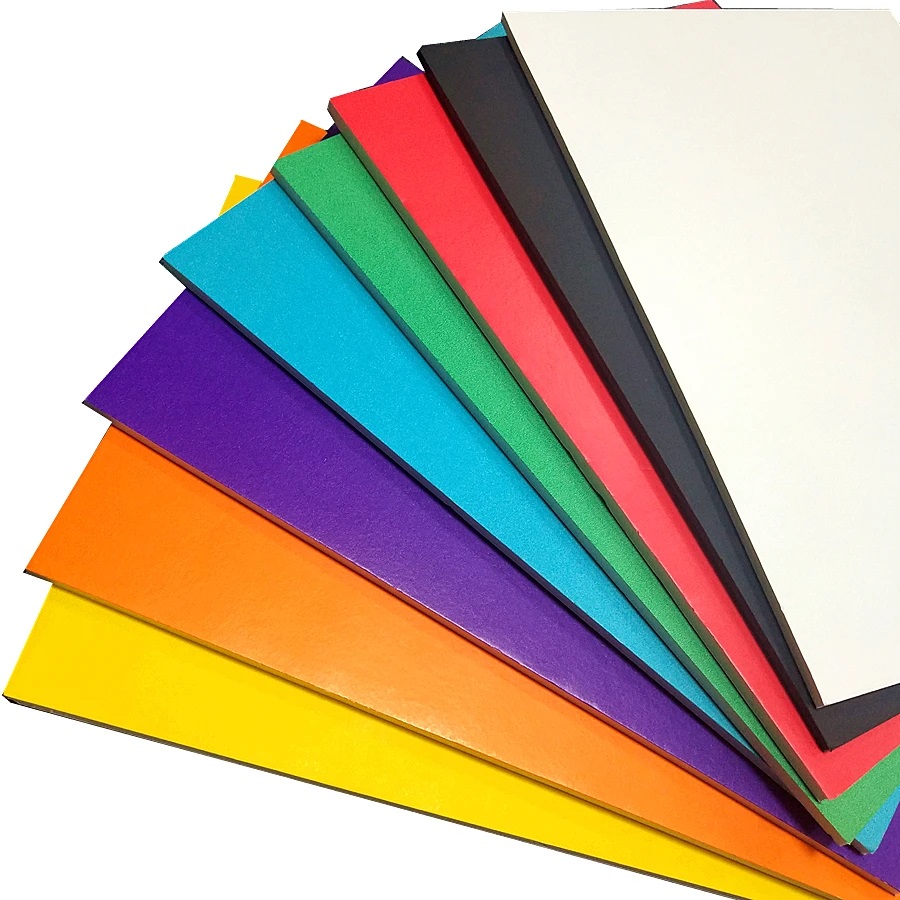
The signage market offers multiple substrates, but they do not perform equally. Selecting the wrong sign material board wastes your budget. Understanding how expanded PVC compares to alternative materials clarifies your purchasing decision.
You must understand the distinct differences between these two common substrates. Standard lightweight foam board features a fragile polystyrene core sandwiched between paper faces. It suits temporary, indoor, non-structural use only. Any moisture exposure destroys the paper facings instantly. Conversely, expanded PVC delivers rigid, moisture-resistant longevity. It contains no paper elements. You can safely wipe it down, expose it to humidity, and rely on its structural integrity for extended periods.
Gatorboard utilizes a dense polystyrene core bonded to wood-veneer faces. This construction makes it highly rigid. However, Gatorboard remains highly susceptible to edge-moisture damage. If water penetrates the unprotected edges, the entire panel swells and delaminates. PVC provides a fully waterproof alternative. While PVC may require thicker gauges to achieve the exact same rigidity as Gatorboard, it offers vastly superior weather resistance.
Aluminum Composite Material (ACM) represents the premium, heavy-duty outdoor standard. ACM features solid aluminum sheets bonded to a polyethylene core. It resists warping under extreme heat. We position expanded PVC as the cost-effective, lighter alternative. PVC excels in medium-term outdoor setups or heavy-duty indoor applications. It shines particularly when your project requires extensive routing, v-grooving, and custom shaping.
Signage Material Comparison Chart | |||
Material Type | Moisture Resistance | Structural Rigidity | Ideal Application |
|---|---|---|---|
Standard Foam Board | Low (Paper faces) | Low | Short-term indoor, temporary POP |
Gatorboard | Medium (Edge risk) | Very High | Indoor mounting, high-end presentations |
Expanded PVC Foam | High (Waterproof) | Medium-High | Mid-term outdoor, robust indoor, CNC routing |
Aluminum Composite | Maximum | Maximum | Long-term permanent outdoor signs |
Specifying the correct material involves analyzing deep technical parameters. You cannot judge a board solely by its visual appearance. Evaluating thickness, density, and surface tension guarantees your PVC foam board performs flawlessly during fabrication.
Thickness directly correlates to structural stability. Manufacturers produce boards ranging from 1mm up to 30mm. You must align the thickness to your specific application framework.
1mm to 3mm: Ideal for flat mounting, laminating, and lightweight curved applications. It requires full backing support.
5mm to 10mm: The industry standard for hanging signage, aisle markers, and standard point-of-purchase displays.
12mm to 20mm+: Necessary for freestanding structural components, dimensional lettering, and load-bearing interlocking displays.
You must actively manage thermal expansion risks in thicker boards. Dark-colored boards absorb significant solar heat when exposed to direct sunlight. They expand quickly. If you lock a thick panel tightly inside a rigid metal frame, the expansion causes buckling. You must design frames incorporating floating channels. This accommodates the inevitable dimensional changes without warping the material.
Core density dictates mechanical reliability. Manufacturers measure density in grams per cubic centimeter (g/cm³). Standard densities range from 0.45 to 0.70 g/cm³. High density guarantees strong fastener retention. If you intend to use mechanical screws or heavy-duty structural adhesives, you need a dense core.
Common Mistakes: Do not purchase low-density "fluted" or poorly extruded PVC for structural projects. These inferior boards compress easily under clamping pressure. They chip aggressively during CNC routing. A weak cell structure leads to stripped screws and collapsed display joints.
Modern printing equipment requires specific surface characteristics. You need a completely smooth, matte finish. The surface tension must remain consistently high to ensure optimal UV-cured digital printing and vinyl film adhesion. Low surface tension causes ink pooling and premature vinyl peeling.
Always request a protective polyethylene film on one or both sides of the board during shipping. Industrial transportation generates friction. Without protective film, the boards develop microscopic pre-print scratches. These tiny abrasions ruin the final finish of high-gloss graphics.
Theoretical material strength means nothing if the fabrication process fails. Understanding machining behaviors and assembly requirements ensures your production team operates efficiently. Proper handling minimizes material waste.
High-quality expanded PVC cuts beautifully. It handles complex geometries easily. However, success depends entirely on your machine settings. You must optimize the feed rate and bit selection. Use single-flute "O-flute" solid carbide bits designed specifically for rigid plastics. If you run the spindle speed too high or the feed rate too slow, the friction melts the polymer core. The plastic welds itself back together behind the bit. Proper chip clearance keeps the tool cool and leaves a glass-smooth edge. It prevents chipping and tearing.
Standard household glues fail on closed-cell plastics. You must utilize specialized solvent cements, similar to PVC pipe cement, to weld the pieces together chemically. Alternatively, high-bond structural acrylic tapes provide excellent invisible joints. Do not use incompatible solvent-heavy construction adhesives. Certain aggressive chemicals melt the delicate polymer core entirely. When using mechanical screws, pre-drill your pilot holes slightly larger than the screw shank. This allows for localized thermal expansion around the fastener.
Gravity and temperature constantly attack unsupported plastics. A large, unsupported sheet will inevitably warp and bow over time. This bowing ruins the aesthetic of your campaign.
You must distribute weight appropriately across the panel. We recommend specific framing systems to combat gravity. Utilize extruded aluminum edge-framing. Install horizontal track systems for large wall murals. For floating installations, place mounting standoffs at strategic intervals. A standard 6mm board requires support intervals every 24 inches to remain perfectly flat.
Sourcing reliable materials requires strict vendor qualification. Inconsistent manufacturing ruins your profit margins. You must enforce rigid standards before committing to bulk pallet orders.
Never accept generic specification sheets. Advise your purchasing team to demand exact thickness and density tolerance sheets. Manufacturing plastics involves acceptable variances. However, excessive variance indicates severe quality control failures. A supposedly "10mm" board measuring 9.2mm indicates poor manufacturing control. This missing thickness compromises your structural calculations. Demand a tolerance of ±0.3mm on premium sheets.
Advertising structures often reside in heavily regulated public spaces. Indoor venues like shopping malls, international airports, and busy trade shows enforce strict fire codes. You must mandate verifiable fire-retardant certifications from your suppliers. Look for industry-standard ratings like UL 94 V-0 or Class 1 / Class A flame spread certifications. An uncertified board creates massive legal liability. Fire marshals will actively dismantle non-compliant structures during event inspections.
We recommend establishing a standardized internal testing protocol. Do not trust marketing brochures blindly. Perform physical validations before buying.
Internal Material Testing Protocol | ||
Test Phase | Action Required | Success Criteria |
|---|---|---|
CNC Machining | Run standard files using O-flute bits. | Clean edges, no melting, minimal dust. |
Print Adhesion | Apply standard UV ink coverage. | Smooth curing, no ink reticulation. |
Tape-Peel Test | Apply cross-hatch cuts, apply strong tape, peel rapidly. | Zero ink lifts from the substrate surface. |
Fastener Test | Drive standard pan-head screws into the core edge. | Core holds thread tightly without splitting. |
Specifying the ideal substrate for your signage projects remains a delicate balancing act. You must constantly weigh core density and panel thickness against the environmental realities of your application. Choosing high-quality closed-cell materials ensures vibrant print results and structural longevity.
Remember, over-specifying a massive 20mm panel for a temporary indoor sign wastes valuable marketing budget. Conversely, under-specifying a thin, low-density board for an outdoor structure risks catastrophic display failure and brand damage. Success lies in matching the material parameters directly to your predefined structural and environmental criteria.
Take proactive action today. Audit your current display failure rates to identify recurring material issues. Request structural samples from verified manufacturers. Run a comprehensive CNC and print test run in your own facility. Validating these materials internally guarantees your next major advertising campaign executes flawlessly.
A: It is suitable for medium-term (1-3 years) outdoor use. However, dark colors can warp under direct UV heat due to thermal expansion. For 5+ year permanent outdoor structures, Aluminum Composite Material (ACM) is structurally superior.
A: Yes. Its closed-cell structure makes it highly suitable for precise CNC routing, V-grooving, and 3D lettering without tearing or edge-fraying, provided the board density is sufficiently high.
A: Sintra is a premium, trademarked brand of expanded PVC foam board known for strict manufacturing tolerances. Generic alternatives can perform similarly but require stricter vetting for density consistency and surface smoothness.
A: Prevent warping by using appropriate thickness (typically 10mm+ for freestanding), utilizing aluminum edge-framing, allowing space for thermal expansion in tracks, and avoiding asymmetrical lamination (which pulls the board to one side).


