
Views: 0 Author: Site Editor Publish Time: 2026-06-15 Origin: Site


Retail environments demand perfection from every fixture on the floor. Visual merchandising requires displays to look flawless under harsh lighting. Store managers need these units to remain safe and structurally sound during heavy foot traffic. You also face strict budgets and tight fabrication deadlines. Specifying the wrong material directly compromises these critical goals. An incorrect plastic grade causes noticeable structural deflection. It creates unwanted optical distortion. It often leads to premature cracking or yellowing in active retail aisles. You cannot afford to guess when specifying these materials. This guide provides an evidence-based framework tailored for visual merchandisers, store planners, and fabricators. You will learn exactly how to evaluate different manufacturing processes. We will guide you through selecting the correct thickness, choosing visual properties, and avoiding common fabrication failures. You will gain the confidence to source the precise materials your retail projects demand.
Process matters: Cast acrylic is mandatory for heavy machining and luxury finishes, while extruded acrylic suits cost-sensitive, high-volume, flat-panel applications.
Thickness dictates lifespan: Under-specifying thickness causes shelving deflection; over-specifying wastes budget and increases fixture weight.
Application drives the finish: High-end cosmetics require high-clarity edge-lit panels, whereas backlit signage requires light-diffusing advertising acrylic.
Maintenance is a hidden cost: Proper cleaning protocols must be factored into the initial material selection to avoid micro-scratching and crazing.
Designers frequently debate between glass and plastic for retail fixtures. Both materials offer distinct advantages. However, polymer technologies have evolved significantly. A modern acrylic sheet for retail display now dominates commercial rollouts. You must understand the physical differences to make an informed decision.
Shipping dense fixtures across the country consumes vast retail budgets. Acrylic weighs approximately 50% less than traditional silica glass of the exact same thickness. This dramatic weight reduction lowers freight costs instantly. It also simplifies modular fixture installation on the store floor. Your installation teams can maneuver large panels without heavy lifting equipment. Wall-mounted displays require fewer structural anchors when using lightweight polymers.
Safety remains a top liability concern for store planners. Busy retail aisles experience constant cart collisions and accidental drops. Acrylic delivers up to 10 times the impact resistance of standard glass. A severe impact might crack a plastic panel, but it rarely shatters into dangerous shards. This characteristic minimizes customer injury risks. It prevents expensive lawsuits in high-traffic shopping environments.
Luxury products demand perfect color rendering. Standard silica glass typically carries a faint green tint caused by iron oxide content. This tint skews the color of the products displayed behind it. Conversely, premium acrylic allows up to 92% light transmission. This exceptional transparency outperforms standard glass effortlessly. It provides true-color product rendering for cosmetics, jewelry, and apparel.
Despite these advantages, you should not eliminate glass entirely. Glass remains inherently superior for absolute scratch resistance. You should specify glass for high-abrasion touchpoints, such as checkout countertops or interactive display tables. If your design demands a plastic alternative in these zones, you must specify a specialized hard-coated acrylic to prevent surface micro-scratches.
Feature | Standard Acrylic | Standard Glass | Retail Impact |
|---|---|---|---|
Weight | ~1.19 g/cm³ | ~2.5 g/cm³ | Acrylic reduces freight and installation labor. |
Impact Resistance | High (10x stronger) | Low (Shatters easily) | Acrylic lowers liability in high-traffic zones. |
Light Transmission | 92% | 89% (Often green tint) | Acrylic ensures perfect color accuracy. |
Scratch Resistance | Moderate | High | Glass wins for heavy-friction checkout counters. |
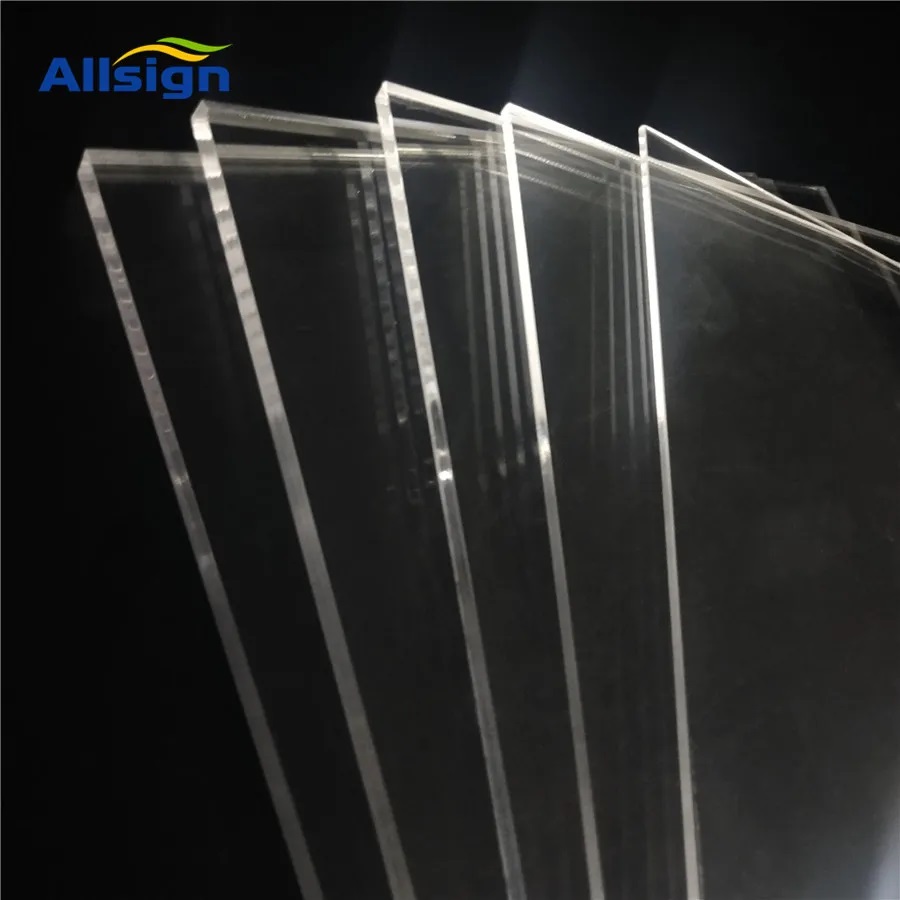
You cannot treat all transparent plastics equally. The manufacturing process fundamentally alters the polymer's molecular structure. This structure dictates how the material behaves during fabrication. You must choose between cast and extruded processing when sourcing an acrylic sheet for display.
Manufacturers produce cell cast acrylic by pouring liquid resin into glass molds. This slow curing process creates a material boasting a very high molecular weight. It represents the premium standard in retail plastics.
Best for: Luxury retail displays, thick structural components, and highly complex fabrication.
Evaluation criteria: Cast sheets offer superior optical clarity. They deliver excellent machining properties. A CNC router bit cuts them cleanly without melting the edges. They also boast high resistance to chemical crazing from aggressive solvent adhesives.
Trade-off: This process carries a higher manufacturing cost. The mold-based production also results in variable thickness tolerances across a single sheet, often fluctuating by +/- 10%. Fabricators must account for this when milling precise interlocking joints.
Extrusion pushes molten polymer continuous through mechanical dies. This high-volume manufacturing method aligns the polymer chains directionally. It introduces inherent tension into the final sheet.
Best for: Vacuum forming, flat POS signage, and budget-conscious multi-store rollouts.
Evaluation criteria: Extruded sheets maintain incredibly consistent thickness across the entire panel. They hit a much lower price point. They also respond faster to thermoforming heat, speeding up production times.
Trade-off: The lower molecular weight creates fabrication challenges. The material turns gummy when routed at high speeds. It remains highly susceptible to stress-cracking during aggressive drilling or when exposed to strong chemical solvents.
Material thickness dictates the entire lifespan of a retail fixture. Under-specifying thickness causes immediate shelving deflection. The shelves sag under product weight, ruining the store's visual presentation. Conversely, over-specifying thickness wastes your material budget. It unnecessarily increases the final fixture weight.
Thin materials perform perfectly in non-load-bearing applications. You should specify 1.5mm to 3mm sheets for flat marketing signs. They work well for small brochure holders, countertop product tents, and simple protective graphic covers. Do not use these thin gauges for structural support.
This mid-range thickness forms the baseline for lightweight merchandise. You can safely build cosmetic bins, apparel cubbies, and standard retail shelving from 4mm to 6mm panels. However, you must incorporate structural support spans every 18 to 24 inches. Unsupported spans longer than 24 inches will eventually bow under continuous static stress.
Premium displays require substantial mass. You must specify thick panels for high-load items like electronics, heavy glass cosmetic jars, or liquor bottles. Freestanding plinths and museum-style pedestals also require 8mm to 12mm material to maintain rigid structural integrity.
Deflection over time remains the number one failure point in poorly specified retail shelving. The polymer experiences "creep," a slow deformation under sustained load. Always calculate the expected product load against the unsupported span length. Your fabricator should run specific deflection formulas before cutting the first panel.
Thickness Range | Primary Application | Max Recommended Unsupported Span |
|---|---|---|
1.5mm - 3mm | Signage, Graphic Covers | Fully supported only |
4mm - 6mm | Lightweight Shelving | 18 - 24 inches |
8mm - 12mm | Heavy Load Shelving, Plinths | 30 - 36 inches |
15mm+ | Structural bases, Luxury vitrines | Custom engineering required |
You must match the material's visual finish to your specific merchandising strategy. Transparent sheets serve as the foundation, but specialty finishes solve complex lighting and branding challenges.
Certain product categories demand absolute visual perfection. You should specify a high clarity acrylic sheet for museum-style vitrines and premium jewelry cases. These environments cannot tolerate any optical distortion. Flawless clarity ensures the customer focuses entirely on the diamond or luxury timepiece, rather than the box protecting it.
Illuminated graphics anchor modern retail design. When designing backlit signage or store lightboxes, a standard transparent panel fails. You must integrate an advertising acrylic sheet engineered for uniform light diffusion. These opal or translucent panels scatter the light evenly. This diffusion prevents harsh LED hotspotting, ensuring your brand logo glows smoothly.
Retail environments often utilize intense overhead track lighting. This harsh illumination creates massive reflections on glossy surfaces. Anti-glare and matte finishes eliminate this problem. They scatter the reflected ambient light. This property proves ideal for wayfinding signage, menu boards, and point-of-sale displays. It guarantees text and branding remain readable from every possible viewing angle.
Visual merchandisers use color to trigger emotional responses. You must evaluate standard color palettes against brand-matched custom extrusions. A visually striking clear acrylic display panel paired with a bold colored base elevates product presentation. Mirrored acrylic also expands spatial perception. It adds depth to tight cosmetic end-caps without the shattering risk of glass mirrors.
A flawless design concept often fails on the fabrication floor. You must establish strict production and maintenance protocols. Ignoring these implementation realities leads to ruined fixtures and costly replacements.
Exposed edges communicate the quality of your fixture. A saw-cut edge looks rough and cloudy. You must specify explicit finishing standards for all visible joints. Demand flame-polished edges for a fast, glossy finish on curves. Specify diamond-machined polishing for perfectly flat, premium straight edges. A high-end display loses all luxury appeal if the edges remain unfinished.
Gluing plastic requires chemical welding, not just sticky adhesives. You must mandate the use of appropriate solvent cements, such as Weld-On 3 or 4. These solvents melt the polymer chains together, creating a seamless bond. Incorrect adhesives cause ugly bubbling. They also weaken the structural integrity at the seams, leading to sudden fixture collapse.
Commercial retail spaces enforce rigorous safety standards. You must verify that your selected material meets local commercial fire compliance. Check for standard industry ratings, such as the UL 94 HB flammability test. Building inspectors will halt a store opening if your large-scale indoor fixtures utilize non-compliant, highly flammable plastics.
Maintenance represents a massive hidden cost in retail. Store employees often ruin expensive fixtures during routine cleaning. You must formally warn store operations against using ammonia-based glass cleaners like Windex. Ammonia breaks down the polymer chains rapidly. This chemical attack causes micro-cracking, known as crazing. It also leaves the material permanently clouded. Specify the strict use of clean microfiber cloths and specialized plastic polishes like Novus.
Common Mistake 1: Using extruded sheets for complex solvent-welded boxes, resulting in severe joint crazing.
Common Mistake 2: Failing to test the product load, leading to visible shelf sag within two weeks.
Common Mistake 3: Allowing store cleaners to use harsh chemicals, destroying the optical clarity permanently.
Choosing the correct polymer for retail environments requires a systematic approach. First, define the structural load to prevent long-term deflection. Next, choose the right manufacturing process. Cast sheets deliver luxury clarity and machining strength, while extruded panels optimize flat-signage budgets. Then, select the specific visual finish to manage lighting and glare effectively. Finally, calculate the precise thickness your spans require.
Do not finalize a multi-store rollout based on digital specs alone. You must ask your material supplier for physical samples. Review the exact thickness tolerances directly with your fabrication partner. Most importantly, build and load-test a single prototype fixture. Testing verifies structural safety and visual impact before you commit significant capital to full production.
A: Yes. Unlike deep scratches in standard glass, minor surface scratches on clear acrylic can be repaired easily. You can buff them out using multi-stage plastic polishing compounds. Deep gouges may require gentle wet-sanding before the final machine polish restores full optical clarity.
A: Standard premium clear acrylic features inherent UV resistance. It will not significantly yellow or degrade for 10 or more years, even in direct window sunlight. However, cheaper alternatives like polystyrene or low-grade polycarbonate will yellow and turn brittle very quickly under UV exposure.
A: Yes. Extruded material is typically 15% to 20% cheaper than cell cast alternatives. The continuous, automated manufacturing process lowers production costs. This makes it an ideal, budget-friendly choice for high-volume rollouts that require minimal complex machining or routing.


