
Views: 0 Author: Site Editor Publish Time: 2026-03-12 Origin: Site


Renovation projects often stall at one key decision: how to upgrade walls, ceilings, and visible furniture surfaces without adding excessive weight, construction complexity, or long installation time. When the goal is to achieve a clean, modern finish with practical maintenance advantages, PVC foam board is increasingly considered for interior decorative use. Rather than focusing on structural construction, this discussion centers on visual enhancement—how Decorative PVC board can reshape interior walls, ceilings, showcases, and feature surfaces with efficiency and design flexibility.
Interior upgrades are usually driven by visual impact, practicality, and budget control. Decorative PVC board fits into this space because it bridges aesthetics and manageable installation.
Traditional wall cladding materials such as stone, ceramic, or thick wood panels can significantly increase load and installation difficulty. PVC foam board provides a lighter sheet-based alternative that can still deliver a refined surface appearance.
In commercial renovations where time and structural load limits are factors, lighter decorative panels help simplify installation planning. Contractors can handle larger sheet formats more easily, reducing labor intensity during fitting and mounting.
Interior designers increasingly favor smooth, continuous surfaces that are easy to wipe and maintain. Decorative PVC board offers a uniform finish that can be painted, laminated, or textured according to design goals.
In retail environments, hospitality spaces, and offices, ease of cleaning supports long-term appearance. Non-absorbent surfaces are especially useful in areas where dust, light splashes, or routine cleaning are expected.
From residential living rooms to hotel lobbies and showroom interiors, PVC foam board adapts to a wide range of visual themes. Whether the objective is minimalism, contrast accents, or layered decorative effects, the material can be integrated into modern design schemes without excessive structural modification.
Walls are often the largest visual element in any room. Upgrading wall surfaces has a direct impact on perceived space quality.
Feature walls serve as focal points. Using Decorative PVC board allows designers to cover large areas efficiently. Sheet-based installation reduces joint lines compared to small tile systems, helping achieve a seamless look.
Because the panels can be cut precisely, they adapt well to both full-wall coverage and framed accent sections.
Decorative PVC board can be produced in different surface finishes, including matte, gloss, or embossed textures. This flexibility supports diverse interior concepts—from sleek, contemporary offices to more expressive retail spaces.
Designers can select finishes that complement lighting schemes and surrounding materials, creating balanced interior compositions.
Even with high-quality sheets, layout decisions influence the final effect. Aligning panels carefully, considering vertical or horizontal orientation, and planning edge treatments all contribute to the finished appearance.
Thoughtful layout planning ensures that decorative PVC board enhances rather than interrupts the intended design flow.
Ceilings often present design opportunities but also impose practical constraints, particularly regarding weight and installation access.
Ceiling installations benefit from materials that minimize structural burden. PVC foam board’s lighter profile makes it easier to mount in suspended ceiling systems or decorative ceiling panels.
This advantage is particularly relevant in renovation projects where existing structures may not accommodate heavy finishes.
In offices, exhibition halls, and retail spaces, ceilings contribute to overall atmosphere. Smooth decorative panels create a refined upper surface that integrates lighting fixtures and ventilation openings without visual clutter.
When uniformity is desired, sheet-based decorative PVC board helps maintain consistent ceiling lines.
In areas such as kitchens, bathrooms, and spa facilities, ceilings may experience elevated humidity. Decorative PVC board provides a surface that is less likely to absorb moisture compared to untreated wood-based panels.
This property supports easier cleaning and helps maintain a consistent appearance over time.
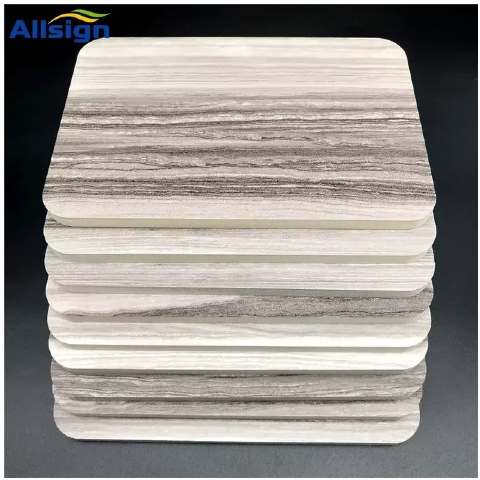
Interior decoration extends beyond walls and ceilings. Furniture-facing surfaces and showcases contribute significantly to spatial identity.
Retail showcases demand visually appealing surfaces that align with brand identity. PVC foam board can be used as veneer panels or decorative cladding for cabinets, shelves, and counters.
Smooth, uniform sheets create cohesive presentation areas that emphasize displayed products.
Color consistency and surface finish play a major role in brand perception. Decorative PVC board allows designers to align wall panels, cabinetry fronts, and display backdrops within the same visual language.
This coordination supports immersive retail environments and professional showroom designs.
For non-structural decorative layers, weight-bearing strength is less critical than appearance and surface quality. PVC foam board provides a suitable base for veneers and surface treatments without unnecessary structural complexity.
Feature walls require materials that can transform space quickly while offering creative flexibility.
Covering a wall with large decorative sheets accelerates renovation timelines. Compared to installing small individual pieces, larger panels reduce joint frequency and simplify alignment.
For commercial renovations where downtime must be minimized, faster installation supports operational efficiency.
CNC routing and cutting enable designers to incorporate grooves, patterns, or layered shapes into decorative panels. PVC foam board’s machinability supports such customization.
From subtle linear textures to bold geometric designs, feature walls can be tailored to suit branding or interior themes.
Minimalist interiors benefit from flat, smooth panels that emphasize simplicity. Conversely, statement walls can integrate layered elements or contrasting finishes. Decorative PVC board adapts to both approaches, depending on design intent.
While the material offers advantages, thoughtful planning ensures optimal results.
Different finishes interact differently with lighting and surrounding décor. Selecting the appropriate surface type supports design consistency.
Glossy panels reflect light more strongly, while matte finishes diffuse it. Understanding lighting conditions helps determine which finish enhances the intended atmosphere.
Proper bonding methods and compatible substrates ensure secure installation. Temperature and humidity levels during installation also influence long-term performance.
Interior Area | Design Goal | Why Decorative PVC Board Fits | Installation Note |
Living room feature wall | Modern focal point | Large smooth panels with clean finish | Align panels carefully for seamless look |
Retail showcase backdrop | Unified brand presentation | Consistent color and surface quality | Ensure proper substrate support |
Office ceiling panels | Clean, professional upper surface | Lightweight and easy to mount | Consider lighting integration |
Bathroom wall cladding | Moisture-tolerant decorative surface | Less prone to humidity-related issues | Seal edges for improved durability |
Furniture veneer panels | Enhanced cabinet or shelf appearance | Smooth sheet suitable for surface finish | Use compatible adhesive system |
Interior upgrades focus on visual clarity, manageable installation, and long-term maintenance simplicity. PVC foam board stands out as a practical decorative material when the objective is to create lighter, cleaner finishes for walls, ceilings, showcases, and furniture-facing surfaces. Decorative PVC board offers design flexibility without excessive structural demand, making it suitable for both residential and commercial interiors. Allsign, as a professional manufacturer with a 50,000㎡ production base and internationally certified production standards, supplies high-quality sheets tailored for interior décor applications worldwide. For projects seeking refined surfaces and efficient installation, contact us to explore suitable specifications of PVC decorative panel solutions for your next interior upgrade.
1. Is PVC foam board suitable for interior wall decoration?
Yes, it is commonly used for feature walls and decorative panels due to its smooth surface and ease of installation.
2. Can decorative PVC board be used for ceilings?
Its lightweight nature makes it appropriate for ceiling panels where reduced load is preferred.
3. Does PVC foam board work for furniture veneers?
It can serve as a decorative surface layer for cabinets and showcases where visual consistency is important.
4. Is decorative PVC board easy to maintain indoors?
Smooth, non-absorbent surfaces allow for straightforward cleaning, making it practical for residential and commercial interiors.


